
The Land Transport Management Amendment Act is a new law coming to roads in New Plymouth (and NZ) in November this year.
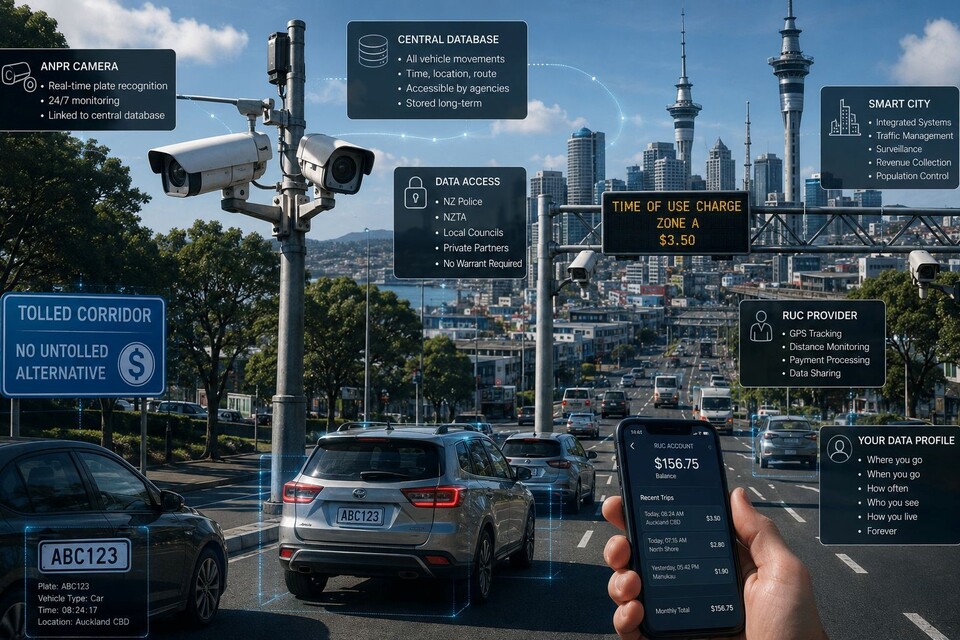
The Land Transport Management (Time of Use Charging) Amendment Act is a new law, passed in November 2025 which comes into force in November 2026.
This will be coming to roads in New Plymouth, and NZ, later this year.
There has been a couple of versions of this information on social media over the last few days. We understand privacy and overreach concerns in those posts, but we have pulled out the general background to the laws, added a bit of background of what has been happening overseas, and letting you know you have a chance to express your view against this before submissions close with the government at the end of the week.
What this law will do is install cameras on our roads that will record your vehicle, your passengers, and people on the footpath beside you, with that data accessible to police, not via a warrant, and not through any independent oversight, but as a built in feature of the legislation itself.
The NZ Council for Civil Liberties submitted against this law and described it plainly as a mass surveillance system, and Parliament still passed the law across National, NZ First, Act and Labour.
- The second bill, the Land Transport (Revenue) Amendment Bill, is now working its way through Parliament. Submissions are open until 12th June – this coming Friday.
The current system requires (some) vehicle owners to display a paper RUC licence on their windscreen, matched against an odometer reading, which is clunky and leaves no data trail.
This new bill replaces the current RUC system entirely. All cars will be moving to the RUC system. This system will have digital subscriptions managed by private companies called "RUC providers," who will be authorised to monitor where your vehicle travels using in-vehicle technology including GPS, issue your licences, manage your payments, and report your movements to the Government.
The government has already gone to market on this, receiving responses from local and international companies who will access the daily movement data of every New Zealander who owns a vehicle.
Historically toll roads in NZ have been for building of a new road, and an alternative free route has been provided, to avoid paying the toll. This bill weakens the current restrictions of turning existing roads into a toll road, and removes the requirement for a feasible untolled alternative route to be provided. Over time you may find yourself with no choice but to pay a toll on a new, or existing road, monitored by a private company, just to get to work or your destination.
Similar systems overseas have also introduced busy roads, or busy cities, where tolls are charged to enter these areas. An example has been London in the UK, where a charge is applied to drive a car into the city. It is something like £21 to drive over the toll boundary in to the city.
This type of technology allows another form of toll (tax) to be applied for using our roads, which we are already paying significant taxes to have maintained by NZTA.
Taken together with the Time of Use Charging Act, what is being constructed is a complete, integrated, commercial surveillance grid covering roads across the country, with the Government and the private sector jointly managing the process.
The attached photo gives a visual view of where and how charges are being applied overseas and billed to each car owner’s cellphone. This new law opens the door for these types of charges to be introduced here in NZ.
- There is a submission window open until Friday 12 June 2026 on the supporting regulations, and you can submit by e-mailing ruc@transport.govt.nz
- If you are opposed to what is being proposed please find the time to send an email
Please share this with others you think may be concerned and want to send a submission.
Posted: 8 Jun 2026