
Why are so many New Plymouth Ratepayers talking about their very large rates increases in 2026 ?
You may have noticed a number of people talking about the very large rates increases this year. People generally were expecting an average of a 4.9% increase – people were thinking some properties may see a 2% increase – some may see 8% or 9%.
The Alliance has been hearing from people who were getting increases from 10% to the worst case of a 42% increase. However basic anyone’s maths is – that is not an average of 4.9% across all ratepayers.
We are also hearing multiple stories of older people, who have lived in their modest home for over 50 years, are fit and well and had no plans of moving, but now find themselves with a $16,500 rates bill and trying to pay that from a single pension of about $28,000 a year.
A number of older people in New Plymouth are being forced out of their homes because their rates have more than doubled in the last 5 years. People all over New Plymouth are finding that their rates have doubled in the last 5 years. It is not possible for homeowners to keep up with these large rates increases going forward.
We had a number of ratepayers who contacted us about their rates increases. We would like to acknowledge an NPDC meeting was put together very quickly with the Mayor, the current Deputy Mayor (Moira George) and the Chief Financial Officer at the Council, to meet with these ratepayers.
It was a 2pm meeting, so a number of working people were unable to make it to the meeting, but they gave permission for the Alliance to discuss the situation with their property.
A 5 year review was undertaken by the NPDC Finance team for each of these ratepayers, but as the meeting progressed and we understood more about how the rates were set in this year’s annual plan, we didn’t have a lot of confidence that much would change for most ratepayers, which a few weeks later has turned out to be the case.
So, what happened with this year’s rates and why did so many properties have increases well over 10% ?
Just to remind everyone, the officials running the council last term were on track for a rates increase of 9.9%, so how people have been affected with this 4.9% figure, would have been a whole lot worse if NPDC savings had not been found over the last 6 months.
A 4.9% increase was mentioned with this year's rates. This figure was in the media, councillors talked about it, a whole lot of ratepayers in New Plymouth thought they would be getting an increase of an average 4.9%. This was discussed a lot after the Annual Plan was signed off and many people knew about this 4.9% figure.
Usually there is a discussion about an average increase in rates, which means some people pay a bit higher than the average and some pay a bit lower.
This year the 4.9% figure WAS NOT an average.
The 4.9% was the increase of what will be collected in total rates in 2026 compared to what was collected in 2025. The total amount of rates to be invoiced by the NPDC in 2026 increased by a total of 4.9%.
So 4.9% is a true figure, but it DID NOT relate to an average of what different groups of ratepayers would pay.
It was a very misleading figure to give to ratepayers, but this was the decision of how this year’s rates information would be communicated.
What individual properties would actually pay varied a great deal with what happened with land valuations done by Quotable Value (QV) back in November 2025.
- If your property value went down, your rates may have reduced or may be under the 4.9% increase.
- If your property value stayed the same, you may have an 8% to 12% increase
- If your property value went up, you may have a 15% to 40% increase.
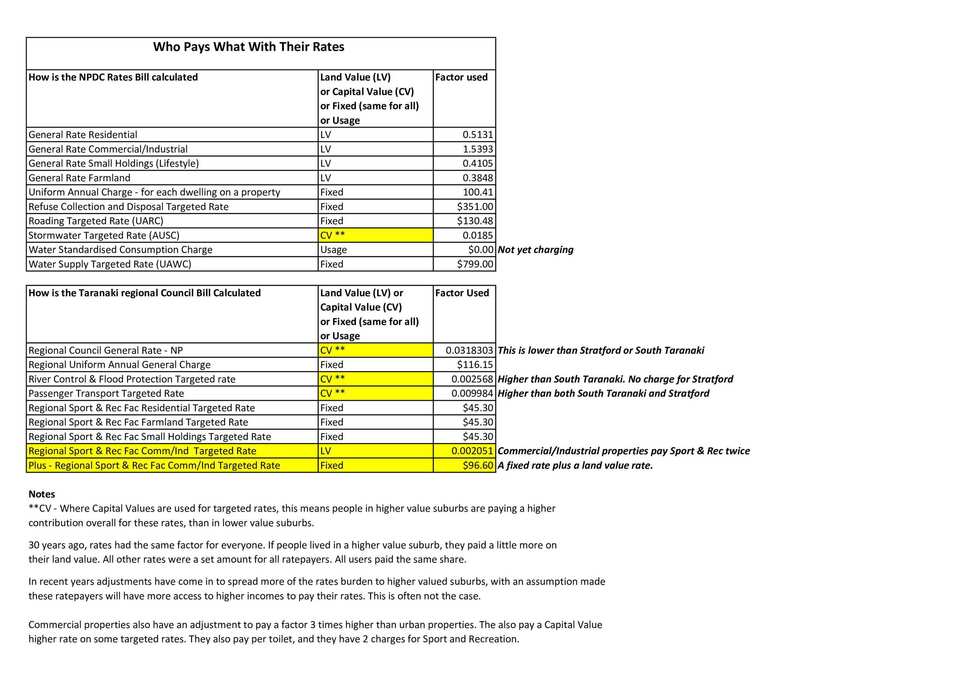
If you have a commercial property, you pay a factor 3 times higher than an urban property, and we have heard from Commercial owners with 35% to 42% increases this year. Last year the factor applied to commercial properties was 4.7 times higher than what urban properties paid, so this would also have been much worse if this hadn't been adjusted in the last 6 months.
Many businesses in New Plymouth are finding business conditions much tougher, and we have multiple industries under pressure with changes happening with oil and gas. There were discussions in our meeting about how fair it is that commercial rates are 3 times higher than what people pay for an urban property. If our businesses can’t keep up with steep increases in costs, and they don’t survive, neither do the jobs so many people are relying on.
What people will pay in their rates is set every year when the Annual Plans/Long Term Plans are agreed on by the elected officials at the NPDC and Taranaki Regional Council. By law, the Plans must fully disclose the Funding Impact Statement for how the rates will be set. All the lines showing what you will pay on your rates bill must be explained in the funding statement.
Both the NPDC and TRC Annual Plans this year show clearly where people will pay more, or less, based on where they live, and all categories show what you pay based on Capital Value, rather than Land Value. Where the capital value method is used for some items, this tends to skew what you pay if you live in a wealthier suburb, and what you pay becomes well above the average for some services.
We have attached a spreadsheet we put together of exactly what factors apply on the different rates bills.
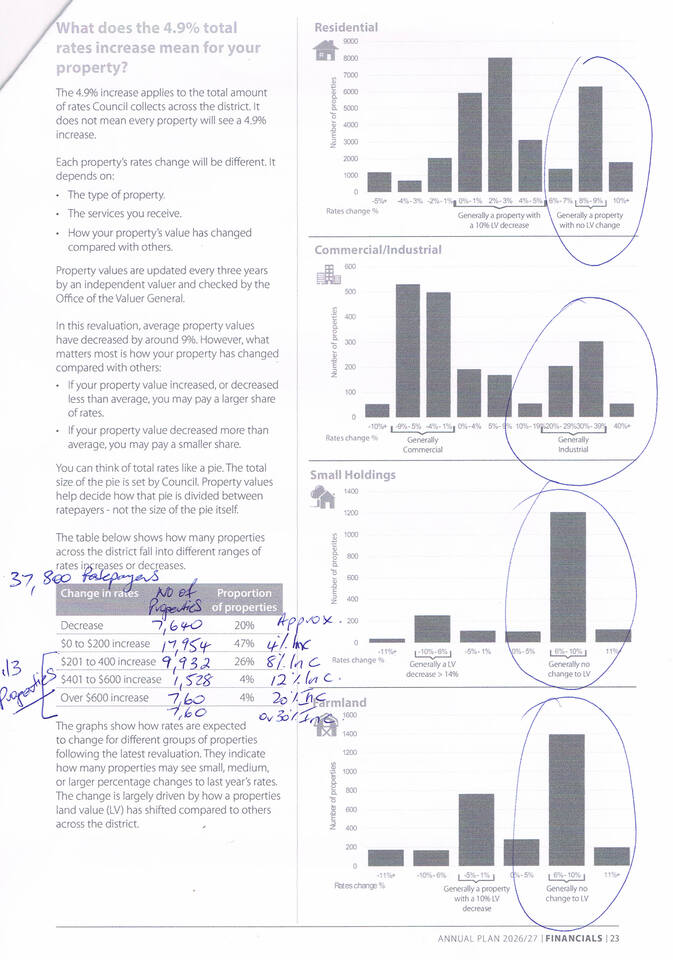
When this year’s NPDC Annual plan was signed off in May 2026, the finance team had provided information which reflected around 13,000 ratepayers would have a reasonably high increase in rates - ranging from 8% to 35%.
We would like to acknowledge that we think the Finance Team did a great job of presenting this complex information.
We have attached a page from the Annual Plan with graphs showing how rates increases would affect the different property types.
The messages below the graphs on these tables show how much rates were likely to change:
- If the value of a residential property did not change, it was expected their rates would be 8% to 10% higher in 2026.
- Industrial properties rates were expected to go up by 20% to 40%.
- Small holdings with no change in land value were expected to have rates increases of 6% to 11%.
- Farmland with no change to land value were expected to have rates increases of 6% to 11%.
Around a third of properties were expected to have rates increases over 8%.
The NPDC Finance team provided us with information about what has happened with increased costs to provide services. These increased costs also affect the targeted rates amounts on the rates invoice:
- Water costs have increased by 18%
- Water metered costs went up by 22%
- Rubbish collection costs have increased by 17%
- Regional Council costs, although much smaller overall than the NPDC charges, went up by 10.4%.
There was also discussion in this meeting about how important property owners’ agreement is with the valuations done by QV every three years. In November and December every three years, it is free for ratepayers to get their valuation assessed by QV, if people think it is too high. If the valuation is too high then the rates paid will be too high.
The importance of the QV valuation was not communicated at all to ratepayers in November last year when a free review could have been done.
That said, the land or capital value has become somewhat redundant when setting what money needs to be collected through rates. Over the 9 years from 2016 to 2025, the NPDC drastically increased costs and debt, and regardless of what property values are, the NPDC now needs to gather enough rates income to service those costs and debt. Rates are apportioned on values of properties, but rates will continue to go up, unless costs and debt come down.
For the longer term picture, so people are much more aware of what is happening next year, the Alliance asked to make some recommendations about how this type of important information is communicated to ratepayers going forward, and a proposal from us will be accepted by the Mayor and Deputy Mayor. We will be asking for feedback soon with how ratepayers think this can be improved.
There has been discussion by the coalition government that rate capping will be introduced for local councils. A 4% rates cap is not going to cut it using the model this year where roughly 13,000 properties had increases over 8%, and a few thousand had increases over 20%.
It was also discussed in this meeting that the rating method being used at the NPDC can be reviewed in this current term, and there is a willingness for this to be done in this term. There are sharp spikes for some areas and properties with the current rating system, and there was a conversation about trying to flatten those spikes in a review.
Of course, those changes can only be made with the agreement of all 15 elected officials.
We have in our diary for next year to make sure we are across the Annual Plan information much earlier, but also in February/March next year, all ratepayers will have a say about what will be spent in the next Long Term Plan.
When that consultation opens, if you don’t like what you are paying in rates, then thousands of ratepayers have to say no to the continual increase in spending through that consultation. We will let you know when this is open for feedback.
Posted: 3 Sept 2026