
Data Centres & Supply – What is happening in Taranaki ? What is happening in NZ ? What is happening Globally ?
Data Centres and Supply – What’s happening in Taranaki ? What’s happening in NZ ? What’s happening Globally ?
Why is the Ratepayers Alliance, whose main concern is local government costs, efficiencies and transparency, looking at an issue like this one ?
On one hand consents are being approved by local councils across the country and local people are generally not involved, and another aspect coming from a lot of everyday people protesting about these data centres overseas, is the cost of water and power is increasing significantly once the data centres are in place, and people are being hit with additional costs to increase infrastructure, and also paying higher costs for supply.
What is happening with these data centres is flowing back into cost of living issues for homeowners. That is why we decided to put out information about this.
What’s happening in Taranaki
New Plymouth
The Tasman Ring Network is a 6,000km trans-Tasman subsea cable linking Auckland, New Plymouth, Greymouth and Invercargill in New Zealand with Sydney, Melbourne and Tasmania in Australia via high-capacity international transport links.
The Tasman Ring Network would be the first dedicated high-fibre-count submarine cable connecting New Zealand and Australia, with an anticipated capacity of up to 540 Tbps. (Terabits per second for those who understand what that means).
The Tasman Ring Network is jointly developed by telecommunications provider Chorus NZ Limited (Chorus) and digital infrastructure company Datagrid New Zealand (which doesn’t have NZ owners but has a NZ name).
Datagrid NZ is also building the Data Centre in Invercargill. This is a link to information about the Tasman Ring Network:
https://www.submarinenetworks.com/en/systems/australia-usa/tasman-ring-network
Who are the people behind Datagrid NZ ? Did we hear anything about the overseas investment office needing to sign the agreement for them to build this data centre in NZ ? This is a link to the overseas investment office approving this sensitive farmland benefit test in NZ, with ownership of the majority of the company by a French citizen, his wife who is an NZ citizen, and a Singapore company:
https://www.linz.govt.nz/our-work/overseas-investment-regulation/decisions/2025-11/202500359
Is the cable coming to New Plymouth going to be for a data centre in New Plymouth ? Our team have been watching for that. Or is the cable coming to New Plymouth to power the Data Centre site in Stratford ? The cale is being promoted as an energy hub for New Plymouth stating it may help to create new businesses. MAY is a word often used when big amounts of our taxes are being used.
Stratford
Contact Energy and a Company called CDC are looking at building the data centre in Stratford on an old retired gas plant site that Contact owns. This is a link to that information here:
https://datacentresnz.com/insights/contact-cdc-stratford-data-centre
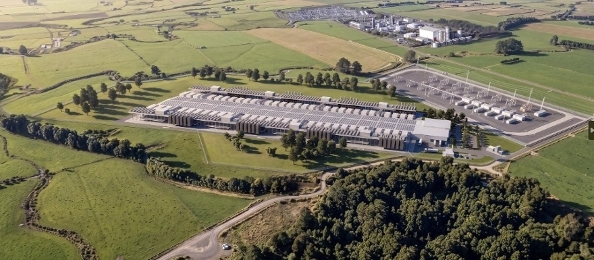
We have attached a picture of the proposed plan for the Stratford site.
Concept illustrations of the proposed data centre to be built near Stratford show the huge scale of the 250-megawatt facility.
Who are CDC Data Centres – a company based In Auckland, and the ACT territory in Australia. This is a link to them here:
How much of the increase in prices for our power bills over the last year has something to do with companies increasing infrastructure for Data Centres ? This is an issue causing very big problems for consumers overseas, with the cost of supply, and in some cases an actual lack of supply.
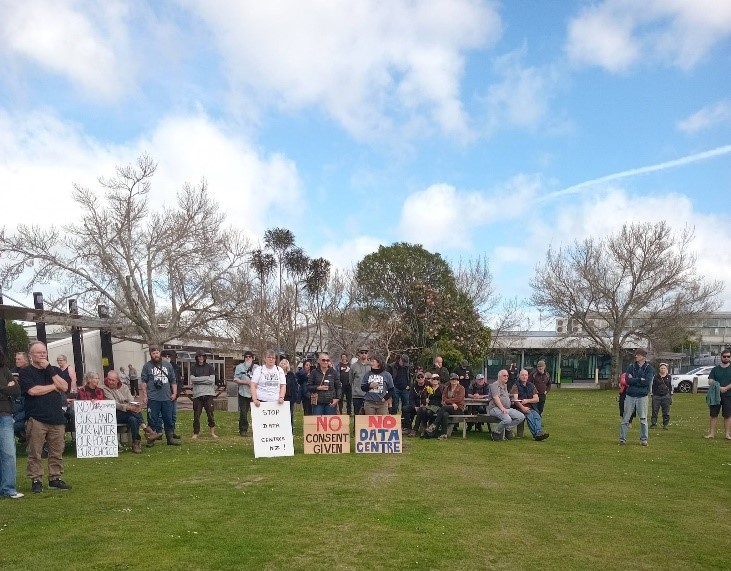
People in Stratford have held a protest about the Data Centre to go in there. We've attached a news photo of that.
What’s happening in NZ
Do people recall the Coalition put in place a minister for the South Island in around 2024 ? It seemed a bit strange at the time. What specifically did the South Island have that needed a Minister for the whole Island ? And why weren’t people consulted on what this Minister would be up to with the purpose of this role being Data Centres ?
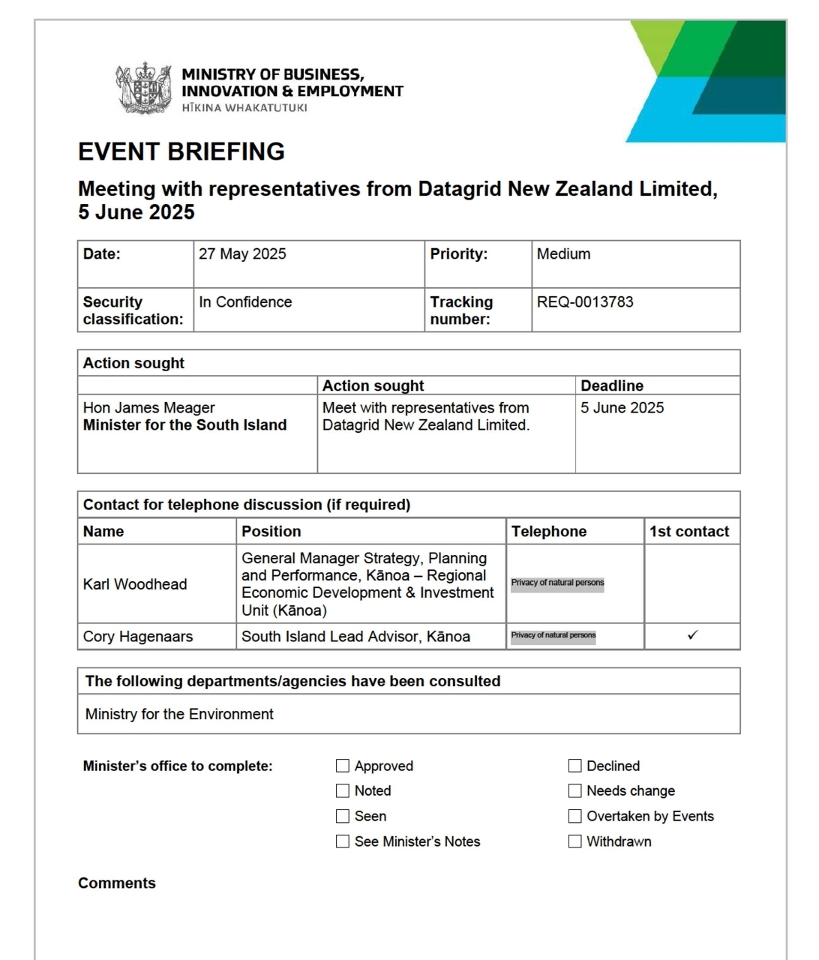
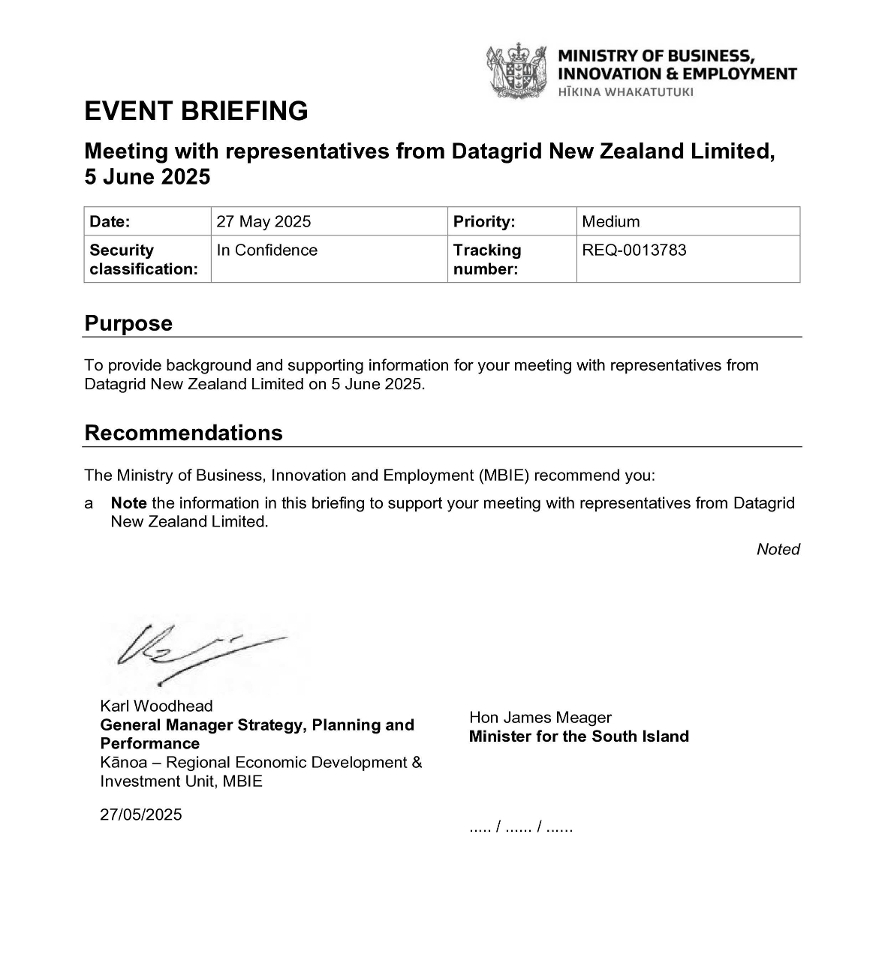
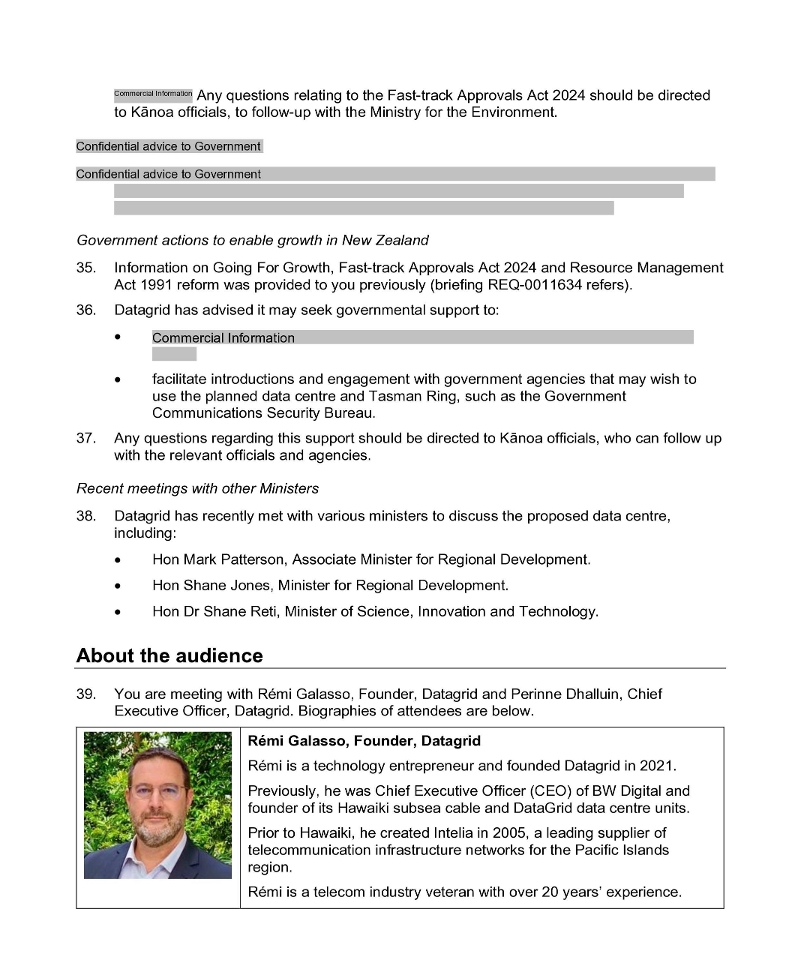
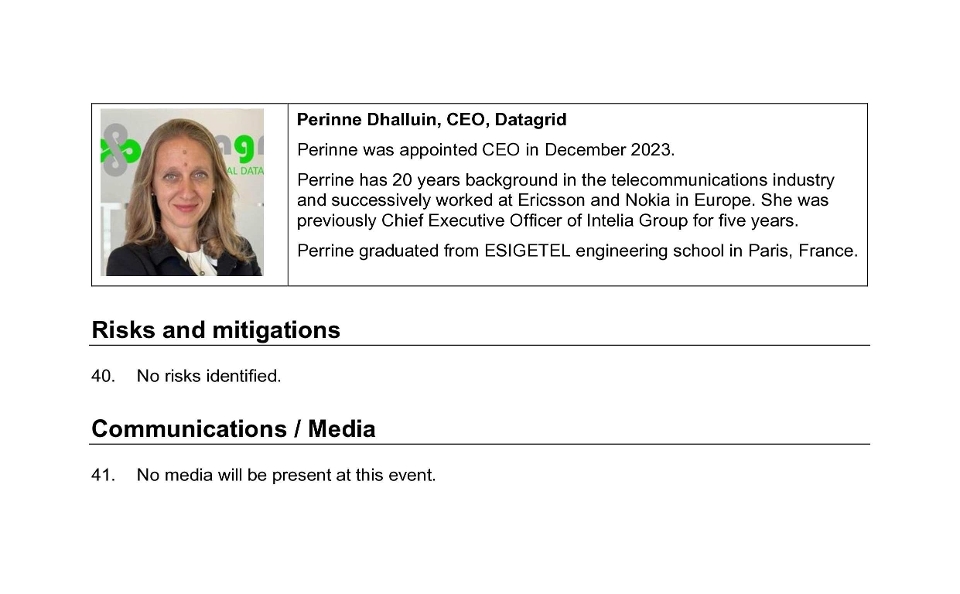
Attached is the briefing note for the minister of the South Island, before meeting with DataGrid, about the data centre to be built in Invercargill. It was a confidential memo not to be spoken about. Yet again, the NZ public is not consulted about decisions being made in Government. Why ?
There are roughly 16 Data Centres already in NZ at this time. So, what will they be doing and how do they affect jobs ? The South Island and Straftford Data centres are not included in this number.
We move into Perplexity AI searches with the following information. Local information has been pulled from NZ for this first part.
How many jobs in NZ are expected to discontinue due to AI and automation from data centres ?
There is no specific, published estimate of jobs that will be discontinued in New Zealand because of data centres themselves. The evidence we do have points in a different direction:
- Data centres in NZ have very low permanent employers (around 50 permanent staff for a large hyperscale site; roughly 1,000 direct employees across all operational data centres nationally).[1][2]
- The main job displacement risk from AI/automation is not tied to data centres as employers, but to how AI is used inside other sectors (retail, finance, admin, professional services, public sector, logistics, etc.).[3][4]
What the NZ evidence says about AI-driven job loss (overall)
Recent NZ-focused analysis and government briefings indicate:
- About 36% of NZ jobs are at high risk of significant AI/automation disruption by 2035, mostly through task automation and role transformation rather than whole occupations vanishing at once.[4]
- Only around 2% of occupations are at high risk of full automation today, but a much larger share (around 30–36%) face high exposure to AI augmentation and task replacement, particularly in administrative, clerical, and professional roles earning $50k–$150k.[3][4]
- Sector-level modelling suggests the largest near-term exposure is in:
- Retail & wholesale trade (~210,000 workers, high risk)
- Financial services & insurance (~120,000, high risk)
- Transport, postal & logistics (~110,000, high risk)
- Public administration (~85,000, medium–high risk)
- Professional, scientific & technical (~180,000, medium–high risk)[4]
Based on this information – around 1,000 jobs may be created at the new data centres, but something like 710,000 jobs are likely to disappear over the next ten years.
Who is actually profiting from these data centres ? It doesn’t look like it’s the everyday people in NZ.
The next 15 links are to the information used to pull the above stats together:
- https://www.theguardian.com/world/2026/jul/10/new-zealand-first-datacentre-concern-locals-makarewa-invercargill-datagrid
- https://www.rnz.co.nz/news/politics/805470/data-centres-in-nz-jobs-creators-or-destroyers
- https://b2bnews.co.nz/news/mbie-maps-nz-jobs-most-exposed-to-ai-automation/
- https://aixiv.science/pdf/aixiv.260531.000002
- https://thespinoff.co.nz/society/15-06-2026/which-jobs-are-most-at-risk-from-the-irresistible-rise-of-artificial-intelligence
- https://www.nzherald.co.nz/nz/new-zealand-tech-job-market-struggles-amid-ai-expansion-economic-downturn/PINUSEJPVFFQFELKJCU6WOZZBU/
- https://www.pwc.com/gx/en/issues/artificial-intelligence/job-barometer/aijb-2025-new-zealand-analysis.pdf
- https://www.maxim.org.nz/content/uploads/2025/02/WEB-AI-and-the-Future-of-Work-Feb-25.pdf
- https://aiforum.org.nz/wp-content/uploads/2025/08/AI-Forum-Productivity-Report_Website_Aug-2025.pdf
- https://aiforum.org.nz/wp-content/uploads/2025/03/AI-in-Action_March2025-Report-compressed.pdf
- https://www.mbie.govt.nz/dmsdocument/14747-labour-market-impacts-of-technology-change-evidence-from-linked-employer-employee-data
- https://www.mbie.govt.nz/dmsdocument/26404-a-future-that-works-report-harnessing-automation-for-a-more-productive-and-thriving-new-zealand-pdf
- https://www.mbie.govt.nz/dmsdocument/5754-artificial-intelligence-shaping-a-future-new-zealand.pdf
- https://www.waikato.ac.nz/news-events/news/nz-is-encouraging-the-use-of-ai-but-its-largely-outsourcing-the-risks-and-societal-costs/
- https://www.pwc.com/gx/en/issues/artificial-intelligence/job-barometer/aijb-2026-newzealand.pdf
What growth is expected in the Data Centre Market ? This is a forecast from a US company.
Demand is being shaped by AI growth, and industry forecasts say data centre capacity is expanding rapidly to keep up. One major 2026 outlook predicts nearly 100 GW of new data centres will be added between 2026 and 2030, with AI driving a large share of that growth.
https://www.jll.com/en-us/insights/market-outlook/data-center-outlook
What is happening overseas ? Why are so many everyday people in local areas protesting ?
Protests and community opposition to data centres have surged globally in 2025–2026, driven mainly by concerns over energy and water use, environmental impacts, noise, and perceived lack of local benefits. The movement is now organised, bipartisan in many countries, and has already blocked or delayed tens of billions of dollars in projects.[impakter][futura-sciences][theguardian]
Where protests are happening
United States (largest and most organised)
- Scale: More than 800 active opposition groups across 49 states by early 2026, up from roughly half that in late 2025.[impakter][futura-sciences]
- Projects affected: At least 75 data centre projects (about $130 billion) were blocked or delayed in Q1 2026 alone—nearly matching the total for all of 2025.[impakter][futura-sciences][broadbandbreakfast]
- Policy response: At least 15 states have proposed some form of moratorium or building freeze; New York enacted a one‑year statewide moratorium on large data centres pending stronger environmental and community protections.[impakter][futura-sciences][nytimes]
- Local bans: Hundreds of local jurisdictions have passed bans or moratoriums; one report cites 500 jurisdictions with bans/moratoriums, including 150 local bans in July 2026 alone.[nytimes][theregister]
- Hotspots: Opposition is reported in rural and suburban areas nationwide, with specific delays noted in states such as Illinois, New York, Texas, California, Virginia, and parts of the Pacific Northwest.[futura-sciences][constructiondive]
United Kingdom and Europe
- UK: Protests have targeted planned facilities in and around London, including a notable demonstration against a proposed data centre on Brick Lane in east London.[theregister]
- Europe-wide: Media report community pushback “from Scotland to India,” with European communities raising similar concerns about grid strain, water use, and climate impacts.[theguardian][wagingnonviolence]
Asia and other regions
- India: Community groups are organising against data centre projects, citing threats to local energy supplies and climate goals.[theguardian]
- Global framing: Activists increasingly link data centre opposition to broader climate and energy justice campaigns, arguing that hyperscale AI infrastructure intensifies resource pressures without proportional local benefit.[theguardian][wagingnonviolence]
Why people are protesting
Common grievances across countries include:
- Electricity demand and grid stress: Data centres—especially AI-focused “hyperscalers”—consume very large amounts of power, raising fears of higher bills, blackouts, and new fossil‑fuel generation.[impakter][futura-sciences][cybersecurity-insiders]
- Water use for cooling: Facilities can use millions of gallons per day, intensifying concerns in drought‑prone areas and competing with residential/agricultural needs.[impakter][wri][thinkbrg]
- Environmental and health impacts: Noise, light, air pollution (including from on‑site gas generation), and greenhouse emissions are frequent complaints, with some communities invoking environmental justice arguments.[impakter][wri][brookings]
- Land use and local benefits: Large campuses on rural or semi‑rural land are seen as bringing construction jobs but few long‑term local jobs, while altering landscapes and property values.[thinkbrg][dispatch][datacenterknowledge]
- Transparency and consent: Use of non‑disclosure agreements between developers and local governments, plus fast‑tracked permitting, fuels distrust and perceptions that communities are being bypassed.[impakter][brookings]
Polling in the U.S. shows around 70–75% opposition to building data centres near respondents’ communities, with strong opposition across party lines.[futura-sciences][nytimes][cybersecurity-insiders][dispatch]
This whole topic is way out of our scope to suggest to people what they should think, or do, which is why we are providing a summary of concerning information and questions. If nothing else, putting this information out may get local people talking about how they feel about this, with one of these data centres going in in Taranaki.
From here people may want to look further into what these data centres are all about and what else is happening in NZ on this topic.
We are aware of a NZ petition on change.org – as we publish this - over 14,000 people have signed it. The link to that is here:
https://www.change.org/p/stop-hyperscale-data-centres-in-new-zealand
Please share this with other people you think may be interested.
Posted: 24 Sep 2026