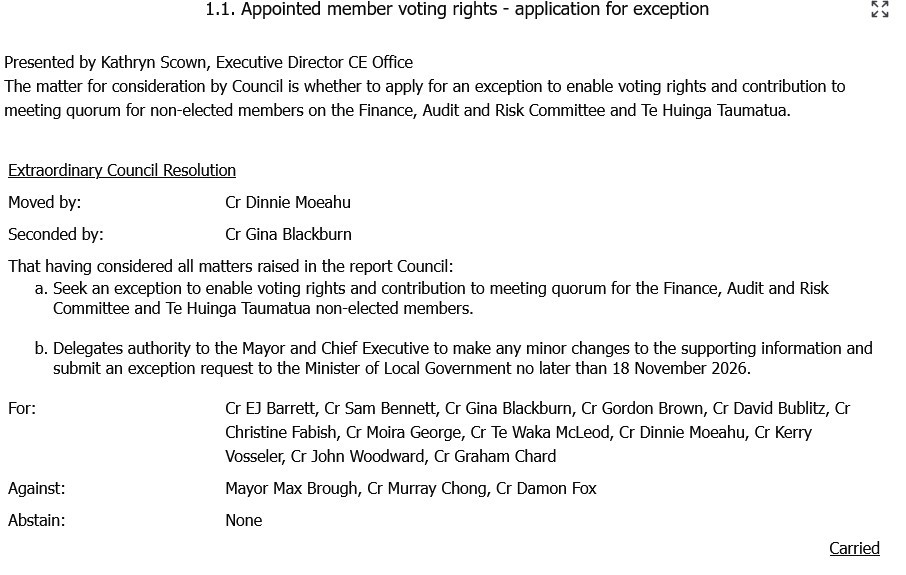
The Government has changed legislation so unelected people can no longer vote on Council decisions. NPDC elected officials have voted 12 – 3 asking the Government to give voting rights back.
The Government has changed legislation so unelected people can no longer vote on Council decisions. NPDC elected officials have voted 12 – 3 asking the Government to give voting rights back.
Democracy has been disappearing from central and local government legislation, a little bit at a time, over a number of years.
On 18th November, in our view, our elected officials voted 12 – 3 to remove a little bit more.
- We have attached a copy of who voted how.
Simon Watts, the Local Government Minister, changed legislation so that unelected people could no longer vote on Council decisions.
Controversial, non democratic decisions were being made in some districts around NZ, to get around how the previous legislation was intended to apply. The Far North District Council was one example of this, which we wrote about at the time. This is why the law was changed.
The new act, The Local Government (System Improvements) Amendment Act 2026 amends New Zealand’s Local Government Act 2002, to refocus councils on core services, improve performance reporting, and reduce pressure on rates. It began taking effect in September 2026.
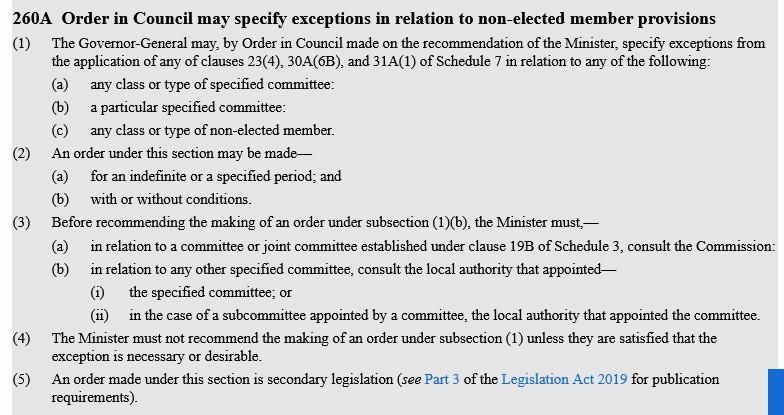
The new legislation allows for councils to apply for an exemption so a committee can continue to vote. We have attached the legislation about this (Section 260A) – which states the Minister must be satisfied the exception is necessary or desirable.
- Our democratic system for Councils is based around all eligible people get a vote.
That vote is to select a group of people who will make our local council decisions. In New Plymouth that is 15 people. If we don’t like how any of those people perform, we have the choice NOT to vote for them next time, and choose someone new.
We also vote for 20 people on community boards, with allocated discretionary budgets they can work with the community to spend. The same rules apply to Community Board elected officials as the NPDC elected officials.
The 15 people we vote for at the NPDC are held to account in a number of ways:
- We can do OIA’s to get information about how they act in their role,
- We can watch all their decisions on a video,
- We can easily contact them by phone or e-mail with our views,
- We can lay a code of conduct complaint,
- They also have standing orders of how they must behave.
And a wide variety of people turn up to vote, so a lot of different opinions choose the people who represent us.
The democratic process gives everyday people a choice, and a process, to make sure the elected officials behave as the rules apply, with the ability to remove them from office.
- This is the democratic system adopted in NZ law.
- Unelected people do not have the same scrutiny. Most people have no idea who the unelected people are who can vote for us, no idea how to contact them, and no ability to remove them.
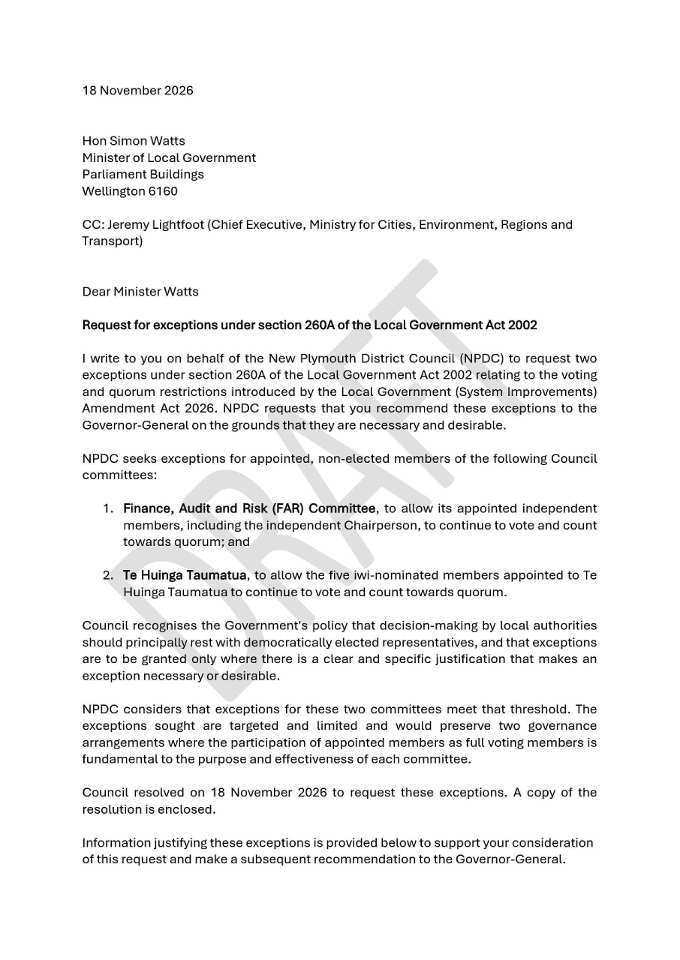
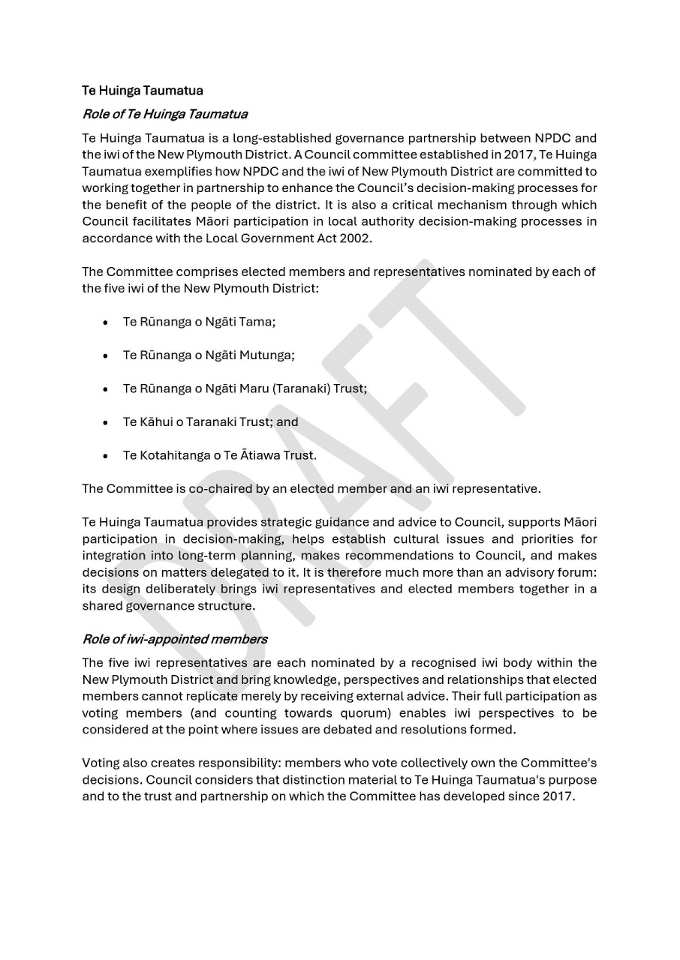
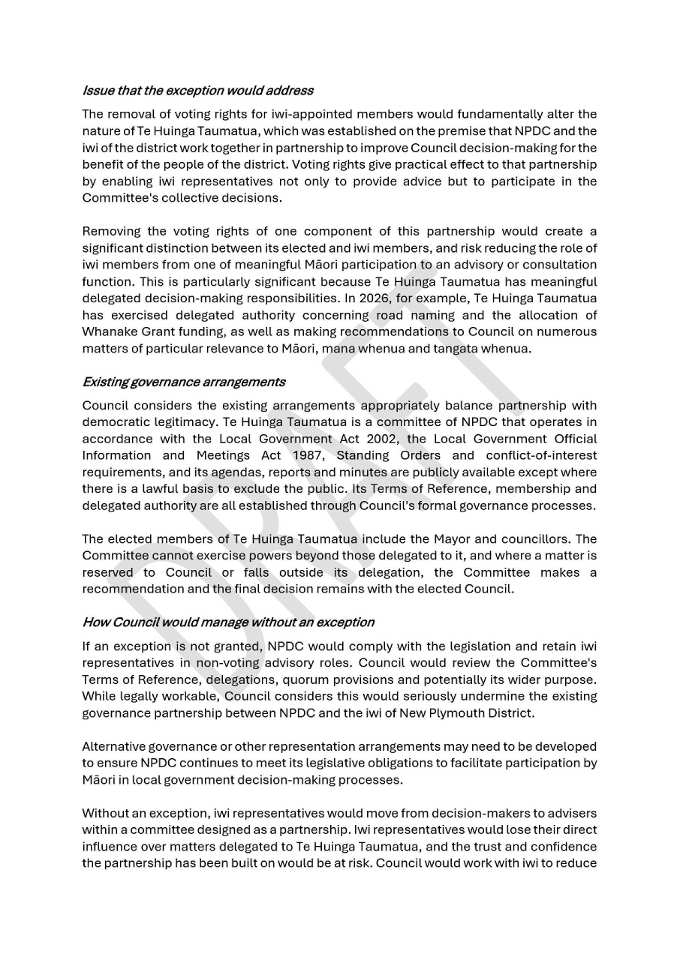
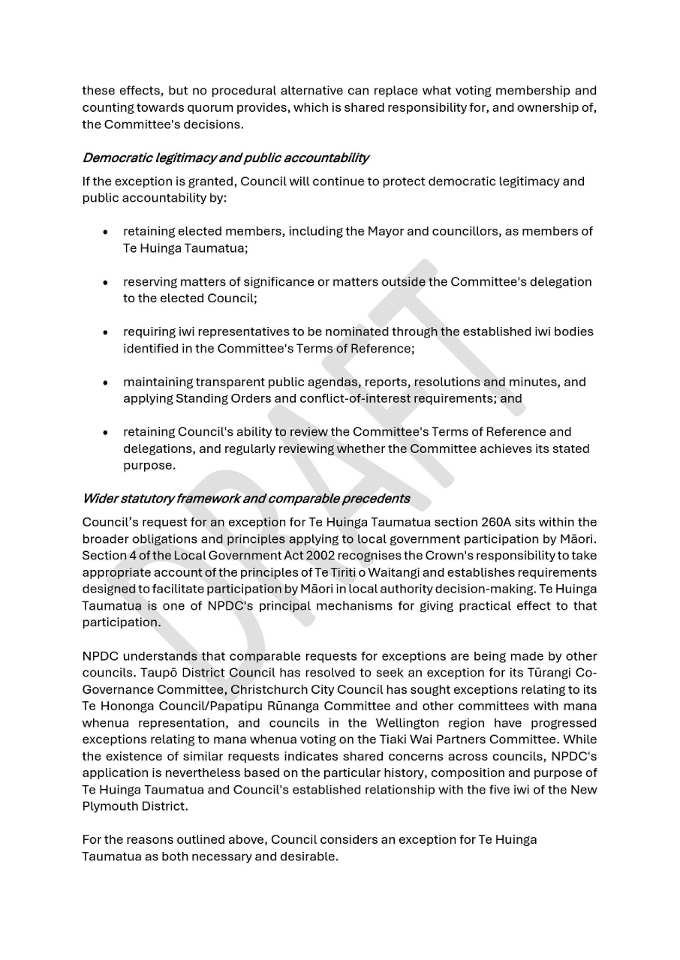
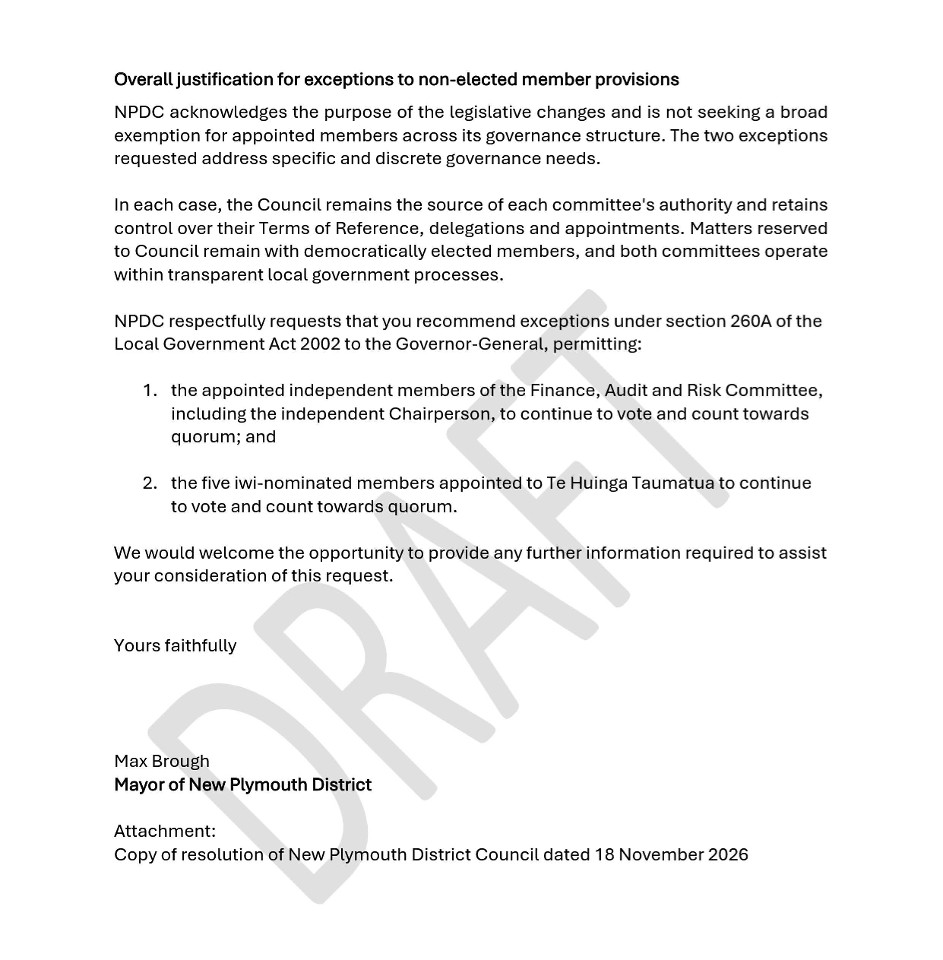
On 18th November our Elected Officials voted 12 to 3 to send a letter to the Local Government Minister asking for an exception to the new law, so that the Finance, Audit and Risk committee and the Te Huinga Taumatua (Maori Representation) committee, can continue to vote through their committee’s.
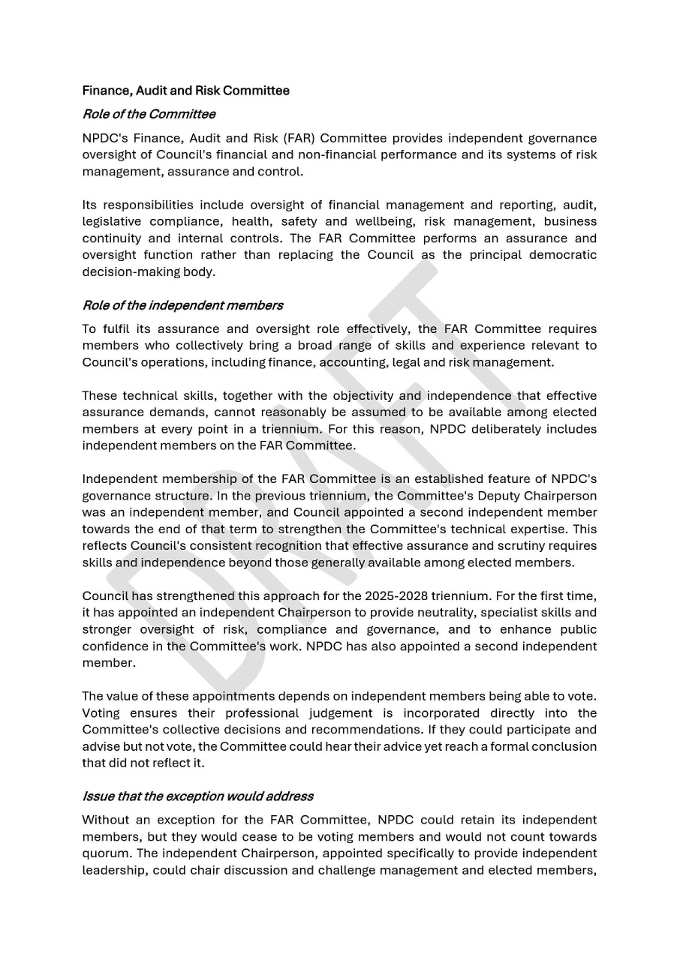
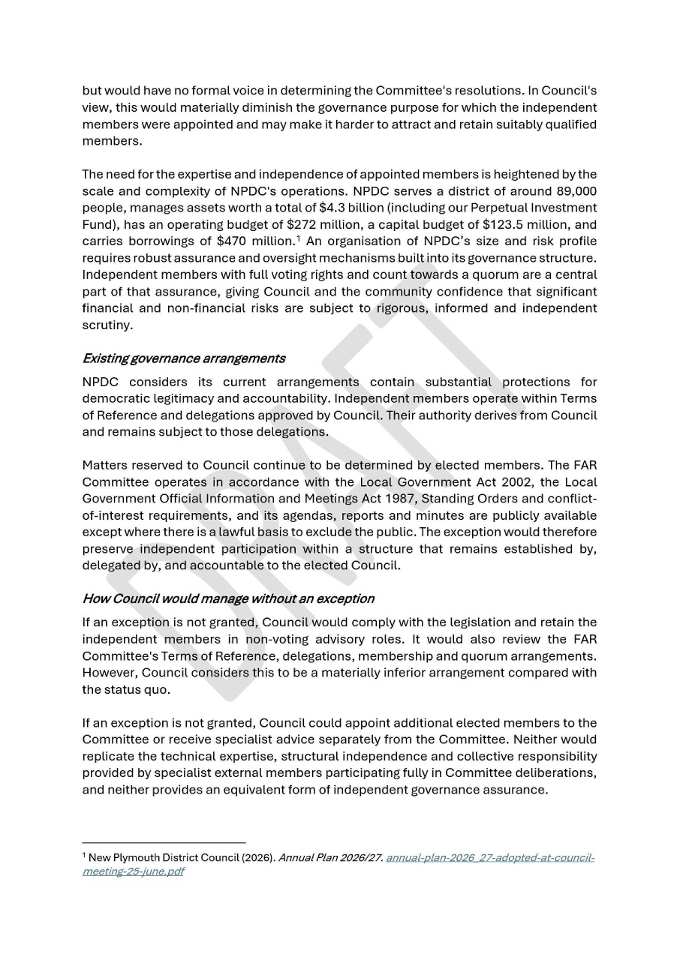
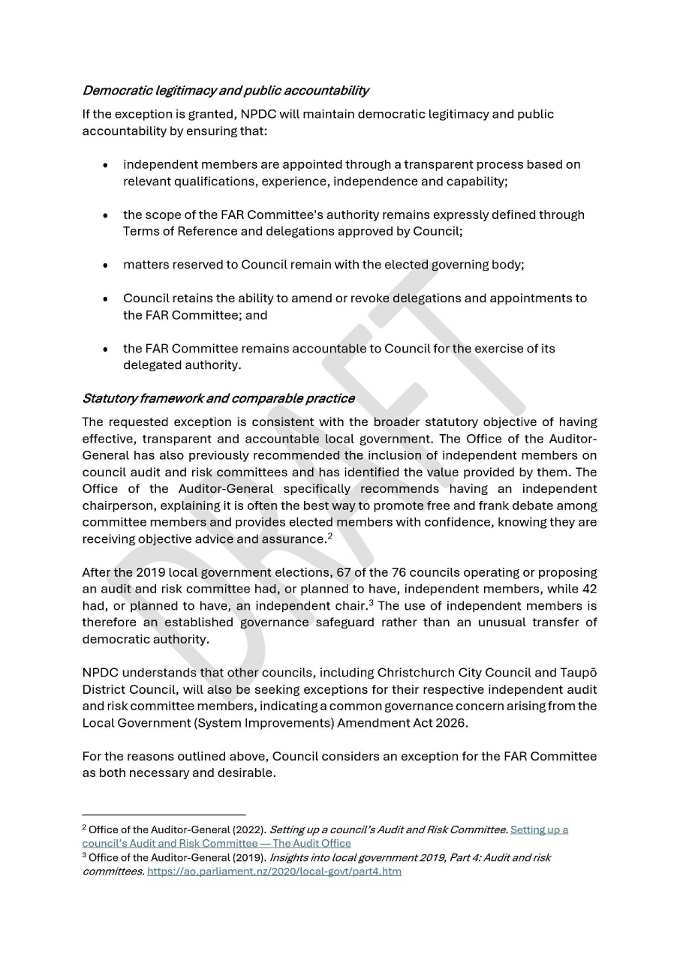
We have attached the letter written to the minister – 8 pages – which is the view of the NPDC staff and the councillors who voted for it – as to why it is so necessary for the 7 unelected people on these 2 committees to continue to vote.
- How many everyday people in New Plymouth already knew the people on these committees had the right to vote ?
- How many people knew when they voted for 15 people to represent them, another 7 people would also be voting on decisions which would affect them ?
The letter sent to Simon Watts states if all the people on these committees can no longer vote then they will leave the committee because they won’t be able to do their job properly and the NPDC won’t be able to find new people to come on to the committees.
The people on these committees get paid between $104 - $130 an hour, plus travel expenses, to be on these committees.
- Can we point out the median wage in NZ (the middle earning point) is $35.96 per hour.
- People on these committees are earning 3.5 times the median wage in NZ. We would like to suggest there is a good chance finding people to sit on these committees won’t be too difficult, even good qualified people.
Of course these committees need to have experts. And, of course these people need to be paid.
In particular the Finance, Audit and Risk committee did not have legal or accounting expertise in 2025 – the GST on the rates was missed through this time. This committee now has an independent Chairperson – so they see both sides of anything suggested – and legal and accounting representatives have been put in place by the current Mayor.
Of course not all of the 15 elected officials will be, or should be, experts on legal and accounting functions, this is why experts are there to provide advice. But advice means advising, it does not mean voting to present a short list to the rest of the 15 elected officials.
The Finance, Audit and Risk committee has 9 members. 7 were elected in the 2025 election, 2 were not. 22% of unelected people on this committee influence the vote.
According to the NPDC website the Te Huinga Taumatua Committee provides strategic guidance and advice to the Council on matters of importance to Māori, and to improve Māori participation in decision-making.
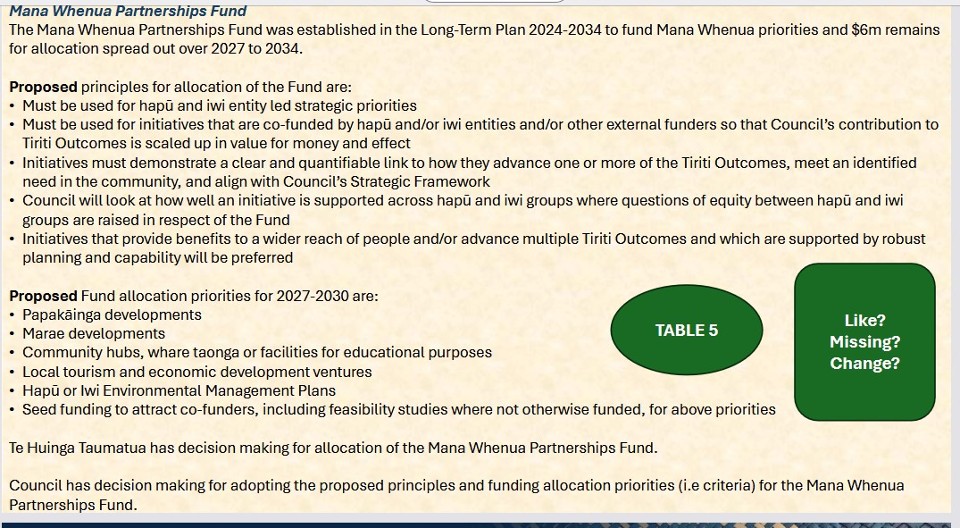
We discovered in workshops earlier this year there is a discretionary budget the Te Huinga committee can vote on to spend. The current balance is $6M which was signed off in the fine print of the hundreds of pages in Long Term Plans.
- We’ve attached the breakdown of the $6M budget that remains for 2027 to 2034 - presented with the Draft Te Tiriti Outcomes workshops earlier this year.
An example of how this committee has voted to spend this budget was for a survey to measure how Te Tiriti was being applied at the NPDC (by Buddle Findlay), what the council should improve, and the results were used to prepare Draft Te Tiriti Outcomes workshops, and a final document to be followed in practice by the NPDC.
- This is an example of how this committee can vote to use their multi million dollar budget.
- The elected officials will vote on the final decision of the Te Tiriti Outcomes Document - but – how many people in the community had absolutely no idea a budget had been spent on this activity.
- Would people have expected that the 15 elected officials would have voted on approving this budget and what it would be spent on ?
The Te Huinga Taumatua committee has 9 members. 4 were elected in the 2025 election, 5 were not. 55% of unelected people on this committee influence the vote.
- How many people when they voted last year realised 5 unelected people would vote on approving budgets to be spent through this committee ?
- We would also ask where is the independent legislation expert on either of these committee’s to make sure these decisions are complying with the actual legislation ?
The Alliance has discovered this year that decisions are being presented as required by legislation - when they are not – an example being co-governance of the Water CCO not being required in the Local Government (Water Services) Act 2025. (We recently presented to Council about this).
- 7 unelected people sit on both of these committees – with the ability to vote.
- True Democracy would be that the 15 people we vote for make the decisions for us.
- But if we are to have an altered version of Democracy, why is there not a committee of 7 people, who represent the people who pay the rates invoices. The people who pay the majority of the income the NPDC receives.
This altered democracy would have ratepayers looking at all decisions being made, and, if non elected people voting is part of how the council runs, the people who receive the actual invoices to pay for the NPDC to operate, should also be paid to sit in a room voting on what they do or don’t want to pay for.
- How will rates ever come down if so many people behind the scenes are working on things everyday people know so little about ?
So, what was highlighted as so “necessary” for voting to continue in the Letter sent to the Local Government Minister, Simon Watts ?
The main concern of the Finance, Audit and Risk committee seems to be that people will leave if they can no longer vote.
- We wonder why they would leave when there will be no other committees to vote on at other councils. Voting rights will be removed from all councils, so why quit when there will be no other jobs like these to go to ?
And respectively, when these positions are paid 3.5 times the median wage, there will be other people happy to do the work if current people do decide they don’t like not being able to vote.
The Te Huinga Taumatua (Maori Representative) Committee seem to have 2 major concerns. Firstly, the removal of the partnership arrangement and co-governance arrangement with the removal of voting rights. And concerns are raised about not honouring Te Tiriti obligations with Section 4 of the new legislation mentioned as being significant with this.
- The new The Local Government (System Improvements) Amendment Act 2026 has amended wording around these arrangements.
The term Te Tiriti is not mentioned in this new legislation.
Section 4 in the new legislation has the following wording:
“In order to recognise and respect the Crown’s responsibility to take appropriate account of the principles of the Treaty of Waitangi and to maintain and improve opportunities for Māori to contribute to local government decision-making processes, Parts 2 and 6 provide principles and requirements for local authorities that are intended to facilitate participation by Māori in local authority decision-making processes.”
There are several other places in the new legislation mentioning working with Maori with similar wording – “maintain and improve opportunities to contribute” – “facilitate participation by Maori in local authority decision making processes”
- Words like co-governance, partnership, governing together are not mentioned in The Local Government (System Improvements) Amendment Act 2026.
The new legislation has removed the 4 well being pillars principles added in 2019 for local councils to use. The social, economic, environmental and cultural well beings are gone.
The new legislation in September 2026 highlights a focus toward cost-effective infrastructure, core services, regulatory functions, and local economic growth, first and foremost.
Exceptions for voting rights must be in place by March 2027.
With an essentially hung parliament result for the country on 27th November, it will be interesting to see if we have a functioning government by March 2027 who is able to decide on the voting rights of council committees.
We will update when we know the outcome from sending the letter to the Minister.
Posted: 29 Nov 2026